Listen to a sample
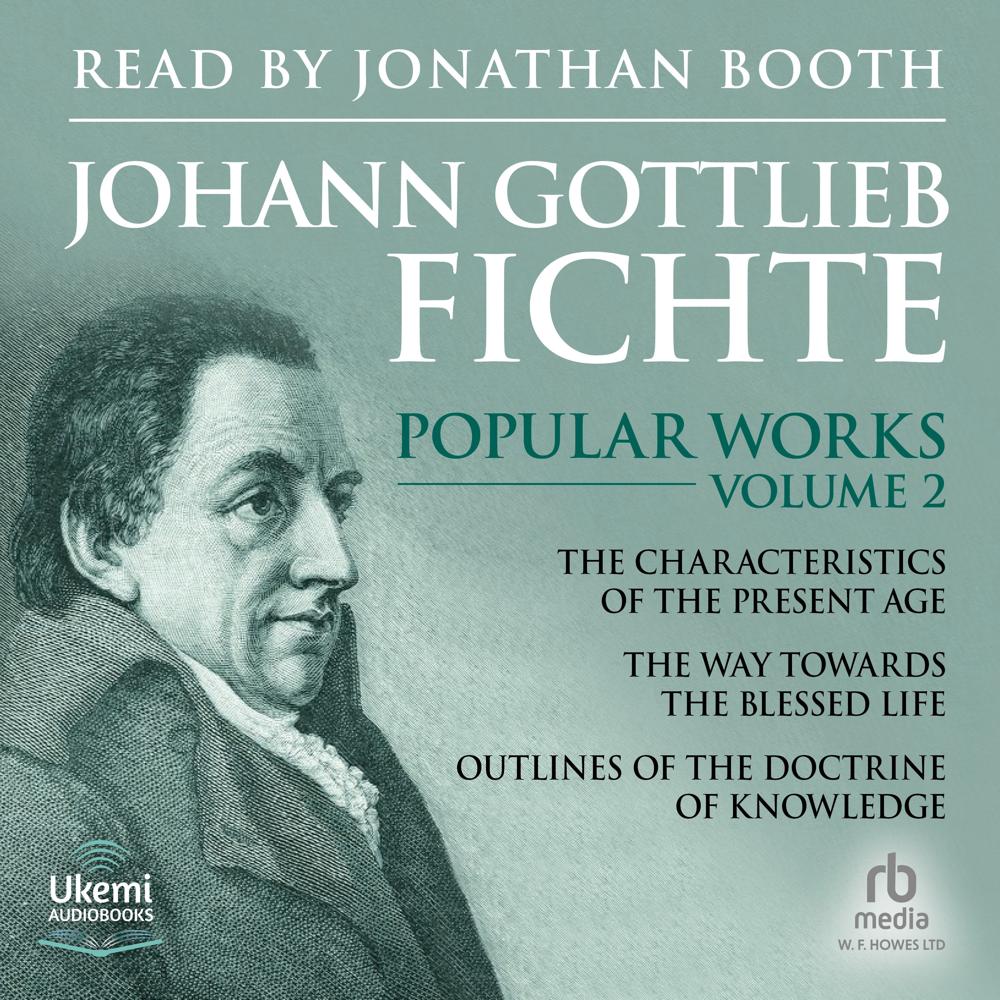
Popular Works Volume 2
- Author
- Johann Gottlieb Fitche
- Narrator
- Jonathan Booth
- Publisher
- W. F. Howes Ltd
- Publish Date
- 28 March 2024
- Run Time
- 17 hours 14 minutes
- Format
- Audiobook
What to expect
There are two substantial lecture series and one essay stemming from his time in Berlin in Popular Works Volume 2: much of Fichte’s important work appeared initially in lectures.
The Characteristics of the Present Age, (1806) consists of 17 lectures in which Fichte presents his ‘speculative philosophy of history’. The series opens with ‘The Idea of Universal History’ in which he ‘divides earthly life into 5 Principal Epochs.’ Against this overview of history and culture, (including the state, civil and political freedom, science and religion) he develops his thesis with particular reference to his ‘present age’ – the time of Voltaire, Rousseau on the one hand and Lessing, Kant and Goethe on the other.
In The Way Towards The Blessed Life or The Doctrine Of Religion (1806) (11 lectures) Fichte considers the relationship between established religion and his particular view on ‘transcendental’ philosophy. His opening statement is ‘Life is Love; and hence Life and Blessedness are in themselves one and the same.’ He continues by examine metaphysics, ontology, mysticism, actual and apparent life, Christianity, and his Doctrine of Being.
The final work in this anthology is Outlines of the Doctrine of Knowledge (1810). It is a concise exposition of Fichte’s Wissenschaftslehre’ but in its strictly scientific form. It had an unusual provenance in that it was printed by Fichte at the conclusion of lectures as a form of a memorandum with 14 short sections. It opens with the question: ‘How this Knowledge can come into being, and what it is in its inward and essential Nature?’
User Reviews
No reviews yet.
Details
- Author
- Johann Gottlieb Fitche
- Narrator
- Jonathan Booth
- Duration
- 17 hours 14 minutes
- Release Date
- 28 March 2024
- ISBN
- 9781004156177
- Format
- Audiobook
- Publisher
- W. F. Howes Ltd
Synopsis
Though born to a poor but pious family of ribbon weavers in in Saxony in 1762, Johann Gottlieb’s exceptional intelligence was apparent from an early age. Remarkably, from this humble background, he earned himself a respected place in the pantheon of late 18th and early 19th century German philosophers. That fact that he is placed between Kant and Hegel, yet still retains a significant and individual presence, says much about his work and personality. He became known, especially, for initiating the concept of ‘German idealism’ (linked with Romanticism and the revolutionary politics which emerged after the Enlightenment). In the 20th and 21st century, his importance and contribution to Western philosophy has been increasingly acknowledged. There are two substantial lecture series and one essay stemming from his time in Berlin in Popular Works Volume 2: much of Fichte’s important work appeared initially in lectures.The Characteristics of the Present Age, (1806) consists of 17 lectures in which Fichte presents his ‘speculative philosophy of history’. The series opens with ‘The Idea of Universal History’ in which he ‘divides earthly life into 5 Principal Epochs.’ Against this overview of history and culture, (including the state, civil and political freedom, science and religion) he develops his thesis with particular reference to his ‘present age’ – the time of Voltaire, Rousseau on the one hand and Lessing, Kant and Goethe on the other. In The Way Towards The Blessed Life or The Doctrine Of Religion (1806) (11 lectures) Fichte considers the relationship between established religion and his particular view on ‘transcendental’ philosophy. His opening statement is ‘Life is Love; and hence Life and Blessedness are in themselves one and the same.’ He continues by examine metaphysics, ontology, mysticism, actual and apparent life, Christianity, and his Doctrine of Being. The final work in this anthology is Outlines of the Doctrine of Knowledge (1810). It is a concise exposition of Fichte’s Wissenschaftslehre’ but in its strictly scientific form. It had an unusual provenance in that it was printed by Fichte at the conclusion of lectures as a form of a memorandum with 14 short sections. It opens with the question: ‘How this Knowledge can come into being, and what it is in its inward and essential Nature?’


About xigxag
xigxag is an independent, UK-based audiobook platform and the UK's only B Corp certified audiobook company. We offer nearly 150,000 audiobooks, all with professional human narration. No AI-generated voices. xigxag is rated an Ethical Consumer Best Buy for audiobooks and a top-rated ethical bookshop.
There is no subscription. You buy the audiobooks you want, you own them permanently, and prices start at $13.95. The more you listen over the year, the less you pay per book, and there is always a selection in Listen for Less from $7.95. You can also send audiobooks as gifts using our audiobook gift cards or in-app gifting.
Every audiobook on xigxag has honest reviews covering both the book and the narration, and our community features make it easy to share what you are listening to, discover what others recommend, and find your next listen.
Download or stream on iOS, Android, or in your browser. Browse the full catalogue at xigxag.co.uk.